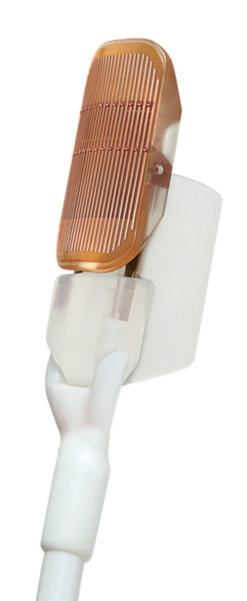
The Barrx™ 60 RFA focal catheter (Model 90-9300) is a single-use endoscopic radiofrequency ablation (RFA) device manufactured by Medtronic. It attaches to the distal end of a flexible endoscope to deliver targeted thermal energy for treating esophageal tissue.
Clinical Indications
- Barrett’s esophagus. Used for the primary ablation of short-to-intermediate segments of non-circumferential Barrett’s esophagus, as well as secondary touch-up treatment for residual tissue following an initial circumferential ablation.
- GI coagulation. Indicated for the coagulation of bleeding and non-bleeding sites in the gastrointestinal tract (such as gastric antral vascular ectasia or radiation proctopathy).
Design & Key Features
- Articulated electrode platform. Features a 2-D articulated electrode array that moves left-to-right and front-to-back, helping maintain uniform contact with the esophageal wall and gastroesophageal (GE) junction.
- Direct visualization. Mounts onto the tip of the endoscope, allowing physicians to see the electrode and target tissue directly during positioning and firing.
- Controlled depth. Pairs with the Barrx™ Flex RFA energy generator (1190A-115A) to deliver uniform, controlled ablation depth while minimizing injury to deeper tissue layers.
Technical Specifications
- Catalog / Item Number. 90-9300 (packaged 1 per box, single-patient use)
- Electrode Dimensions. 15 mm × 10 mm
- Catheter Shaft. 160 cm length; 4 mm diameter
- Endoscope Compatibility. Fits standard flexible endoscopes with a distal tip outer diameter of 8.6 mm to 9.8 mm
- Treatment Capacity. Rated for up to 80 ablations per session
Safety & Potential Risks
- Common side effects. Temporary chest or throat pain and difficulty swallowing (dysphagia).
- Procedural complications. Bleeding, esophageal stricture (narrowing), mucosal laceration, perforation, infection, aspiration, pleural effusion, or cardiac arrhythmia.
Pricing and Availability
Medtronic does not publish fixed retail prices for the Barrx™ 60 RFA focal catheter (Model 90-9300), as clinical pricing relies on direct hospital contracts and regional tender agreements. However, secondary medical surplus distributors list single, in-date units in the U.S. at approximately $1,999, while European hospitals must request quotes directly through local Medtronic representatives.
United States Pricing & Availability
- Direct & Contract Suppliers. Major medical-surgical distributors such as Medline carry item 90-9300 (listed under Medline SKU
SWD909300), though pricing is restricted to registered healthcare accounts. - Secondary Market (Clinical In-Date). Independent surgical resellers like Synergy Surgical list single, sterile, in-date boxes (1 catheter per box) for $1,999.00 USD with immediate stock availability.
- Non-Clinical / Training Units. Expired or surplus stock intended strictly for veterinary, R&D, or educational training is frequently listed on marketplaces like DOTmed and Medical Materials ranging from $40.00 to $396.00 USD depending on expiration date.
Europe Pricing & Availability
- Direct Procurement. The device holds CE marking and is actively available across the EU and UK. Medtronic distributes the catheter directly to hospitals and endoscopy centers rather than through open e-commerce storefronts.
- Regional Inquiries. Public list prices are not published in Euros or British Pounds. Facilities in Europe and the Balkans must contact their local Medtronic UK, Medtronic Ireland, or authorized regional distributor (such as Papapostolou in Greece or local Adriatic/Balkan medical device representatives) to obtain a formal tender quote.
- Cross-Border Surplus. European B2B medical exchanges such as Doc-Market occasionally list Medtronic RFA consumables on a “price on request” basis with shipping across Europe, including Bosnia and Herzegovina, Croatia, and EU member states.
References
Endoscopic Therapy in Barrett’s Esophagus
A simplified regimen for focal radiofrequency ablation of Barrett’s mucosa using the HALO 90 System: a randomized multicenter trial comparing two ablation regimens
Endoscopic management and follow-up of patients with a submucosal esophageal adenocarcinoma
Leave a Reply