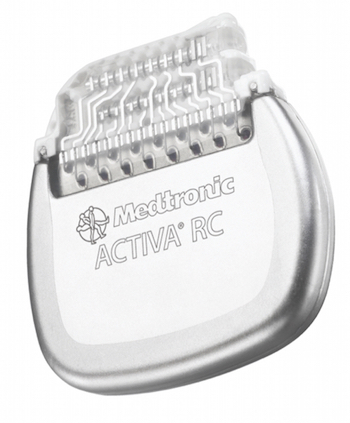
The Activa™ RC Neurostimulator is a dual-channel, rechargeable implantable pulse generator developed by Medtronic for Deep Brain Stimulation (DBS) therapy.
Clinical Indications
- Parkinson’s disease. Delivers bilateral stimulation to the subthalamic nucleus (STN) or internal globus pallidus (GPi) to manage advanced motor symptoms.
- Essential tremor. Provides unilateral or bilateral stimulation targeting the ventral intermediate nucleus (VIM) of the thalamus.
- Dystonia. Approved in Europe and under humanitarian device exemptions in the US to help manage chronic, treatment-resistant primary dystonia.
Key Specifications & Features
- Battery longevity. Features a rechargeable battery with a service life of up to 15 years (9 years under older UK/EU labeling depending on settings), reducing the need for surgical battery replacement.
- Lead compatibility. Supports up to two leads (1 or 2 channels) and is compatible with Medtronic SenSight™ Directional Leads (1-3-3-1 electrode configuration) for targeted current steering.
- Programming flexibility. Stores up to four therapy groups, with up to two programs per lead (configuring pulse width, rate, and amplitude).
- MRI compatibility. Labeled as MR Conditional, allowing full-body 1.5T MRI scans under specific conditions with active stimulation.
System Components
- Patient Recharger (RS6200). A wireless, wearable external charging system used to recharge the implanted battery through the skin.
- Patient Programmer (TH90D01 / TH90D02). A handheld device that allows patients to check battery status, turn stimulation on or off, and switch between clinician-preset therapy groups.
- Clinician Programmer (CT900E / CT900F). An Android-based tablet running SureTune™ 4 software used by physicians to customize stimulation parameters and review stored therapy logs.
Contraindications & Safety Warnings
- Strict contraindications. Patients with an implanted Activa™ RC must never undergo diathermy (shortwave, microwave, or therapeutic ultrasound) or Transcranial Magnetic Stimulation (TMS), as these can cause severe tissue damage or device failure.
- Electromagnetic interference (EMI). Strong magnetic fields or certain security scanners can inadvertently turn the device off or alter stimulation.
- Rebound effects. Sudden cessation of stimulation due to battery depletion or device shutoff can cause a rapid, severe return of movement disorder symptoms.
Availability and Pricing
The Medtronic Activa™ RC is largely phased out in favor of the newer Medtronic Percept™ RC, though it remains supported for existing patients and appears occasionally on secondary surplus markets.
Availability in Europe & the US
- United States. While the Activa™ RC remains listed on the Medtronic US Healthcare Professionals portal, clinical centers have transitioned new implants to the Percept™ RC (which adds BrainSense™ neural sensing technology and faster charging). Direct clinical orders for Activa™ RC require an active hospital or clinic account with Medtronic.
- Europe. Following CE mark approval of the Percept™ RC, Medtronic shifted European commercialization to the Percept™ portfolio. Existing Activa™ RC devices remain supported under EU/UK medical device regulations, and compatible accessories—such as the RS6200 Patient Recharger and SenSight™ extensions—continue to be supplied through regional Medtronic representatives.
- Secondary & Surplus Markets. Because implantable pulse generators are Class III sterile medical devices, they are not sold directly to consumers. Surplus or expired units (intended strictly for non-clinical, veterinary, or training purposes) occasionally surface on medical liquidation platforms.
Pricing & Reimbursement Context
Medtronic does not publish retail list prices for active implantable neurostimulators, as hospital pricing is governed by confidential group purchasing organization (GPO) contracts and national tender agreements. However, secondary market listings and healthcare reimbursement schedules provide clear cost benchmarks:
- Secondary / Surplus Unit Listings. On medical surplus marketplaces, single-unit expired stock of the Medtronic MDT37612 Activa™ RC (box of 1) is listed at $4,638.40 USD on DOTmed and $2,899.00 USD on Synergy Surgical. (Note: Expired sterile devices cannot be used for human implantation.)
- US Medicare Reimbursement (2026). According to the Medtronic 2026 DBS Coding and Payment Guide, inpatient hospital reimbursement (MS-DRG) covering the device and generator-only implantation/replacement ranges from $12,572 to $28,097 (national average), depending on patient complications and comorbidities. Total commercial and out-of-pocket DBS procedure costs in the US typically fall between $35,000 and $80,000 as reported by Bookimed.
- European Healthcare Tariffs. Across Western Europe (such as France, Germany, and Italy), DBS systems are reimbursed through national public health insurance Diagnosis-Related Group (DRG) tariffs rather than itemized device billing. All-inclusive DBS surgical packages in Europe generally range from €15,000–€25,000 in Central/Eastern European hubs (e.g., Poland) to €50,000–€75,000+ in Western European centers (e.g., Germany).
References
Neurostimulation Devices for the Treatment
of Neurologic Disorders
Leave a Reply