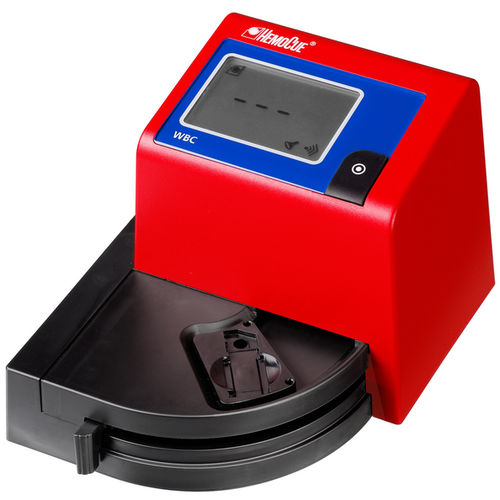
In vitro diagnostic (IVD) devices for white blood cells (WBCs) are medical tools used outside the body to measure, identify, and analyze these immune cells to help diagnose infections, inflammation, leukemia, and other blood disorders.
Common IVD Devices and Systems
- Hematology Analyzers: The primary laboratory instruments used for a Complete Blood Count (CBC). They use laser-based flow cytometry or electrical impedance to count and categorize WBCs into sub-types like neutrophils and lymphocytes.
- Point-of-Care (POC) Systems: Portable devices like the HemoCue WBC System provide quantitative WBC counts in minutes, allowing for immediate clinical decisions during a patient visit.
- Flow Cytometers: Advanced IVDs that use fluorescence-tagged antibodies to identify specific cell markers (e.g., CD4 or CD8) for diagnosing complex conditions like HIV or hematological malignancies.
- Automated Digital Morphology Systems: Devices such as the CellaVision DC-1 automatically locate and capture images of WBCs on peripheral blood smears for review by trained professionals.
- Specialized Rapid Tests: Innovative tools like the Cytovale IntelliSep test analyze the biomechanical properties of WBCs to provide a sepsis risk score in roughly 8 minutes.
Regulatory Framework
To be used in clinical practice, these devices must comply with strict international standards:
- FDA Approval/Clearance: In the U.S., IVDs are regulated by the Food and Drug Administration to ensure safety and effectiveness.
- IVDR (EU 2017/746): In the European Union, devices must meet the In Vitro Diagnostic Regulation (effective as of May 2022) to obtain a CE mark for sale.
Clinical Applications
- Infection and Inflammation: Detecting elevated WBC counts (leukocytosis) or low counts (leukopenia).
- Leukemia Diagnosis: Identifying abnormal cell populations through immunophenotyping.
- Blood Product Quality Control: Kits like the BD Leucocount are used to count residual WBCs in “leukoreduced” blood products intended for transfusion to prevent adverse reactions.
Products & Pricing
In vitro diagnostic (IVD) devices for white blood cell (WBC) analysis range from portable point-of-care (POC) tools to high-throughput laboratory analyzers. As of 2025, market prices vary significantly based on automation level and whether the device provides a simple total WBC count or a complex 5-part differential.
1. Point-of-Care (POC) Analyzers
These are compact, portable devices designed for immediate results in clinics or at the bedside.
- HemoCue WBC System: Provides a total WBC count in roughly 3 minutes.
- Price: Approximately $2,700 – $4,100 USD.
- HemoCue WBC DIFF System: A more advanced version that provides a 5-part differential (neutrophils, lymphocytes, etc.).
- Price: Approximately $5,400 – $6,500 USD (£5,389).
- PixCell HemoScreen: Uses a lab-on-a-cartridge technology for a complete 5-part differential.
- Price: Consumable test kits (50-count) cost roughly $650 USD; the reader itself is often part of larger clinical lease or finance agreements.
2. Compact Benchtop Hematology Analyzers
Small-to-medium lab analyzers that handle a larger volume of samples.
- Horiba Yumizen H500: A 5-part differential analyzer used in satellite labs and oncology centers.
- Price: Approximately $6,000 – $7,500 USD (converted from ~₹5–6.25 lakh).
- Contec BC300: A semi-automatic biochemistry and hematology analyzer.
- Price: Entry-level models start as low as $450 – $600 USD for basic diagnostic needs.
3. High-Throughput Laboratory Systems
These are used in large hospitals and reference labs.
- Examples: Sysmex XN-Series, Abbott CELL-DYN, and Beckman Coulter UniCel.
- Price Range: Generally $50,000 to over $100,000 USD. Prices for these systems are typically quoted directly to institutions and may include service contracts and reagent lease agreements.
Summary Comparison Table (2025)
| Device Type | Example Model | Estimated Price (USD) | Primary Use |
|---|---|---|---|
| Basic POC | HemoCue WBC | $2,700 – $4,100 | Rural clinics, ER |
| Advanced POC | HemoCue WBC DIFF | $5,400 – $6,500 | Urgent care, oncology |
| Benchtop | Horiba Yumizen H500 | $6,000 – $7,500 | Small laboratories |
| High-End Lab | Sysmex/Abbott Systems | $50,000 – $100,000+ | Major hospitals |
Free References
Lab-on-chip-based cell separation by combining dielectrophoresis and centrifugation
Rapid testing of red blood cells, white blood cells and platelets in intensive care patients using the HemoScreen™ point-of-care analyzer
Leave a Reply