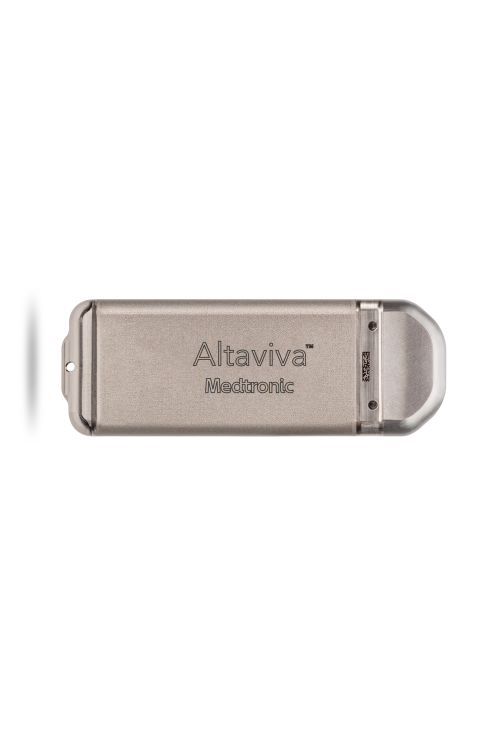
The Altaviva™ system is a minimally invasive, implantable tibial neuromodulation device developed by Medtronic to treat urge urinary incontinence (UUI). Approved by the FDA in September 2025, it is designed for adults whose bladder control symptoms have not improved with, or who cannot tolerate, conservative treatments like behavioral therapy or medications.
How It Works
- Targeted nerve stimulation. The small, leadless neurostimulator (Model P7850N) is placed just beneath the skin near the ankle. It delivers gentle electrical pulses to the tibial nerve.
- Brain-bladder communication. Signals travel from the tibial nerve up toward the sacral plexus (near the tailbone) and communicate with the brain, helping to regulate involuntary bladder contractions and reduce sudden urges and leakage.
- Automated therapy. Once programmed, the device automatically delivers scheduled stimulation without requiring daily manual adjustments.
Procedure & Key Features
- Minimally invasive placement. The implant is inserted through a small (roughly 2 cm) incision near the ankle during an outpatient procedure that requires only local anesthesia—no general anesthesia, sedation, or intraoperative imaging is needed.
- Same-day activation. Therapy is turned on the same day as the procedure.
- Long battery life. The rechargeable battery is expected to last 15 years and only needs recharging about 1 to 2 times per year using a wireless recharger held in place by an ankle band.
- MRI compatibility. The system is MR Conditional, allowing for 1.5T and 3T full-body MRI scans under specific safety guidelines.
Clinical Outcomes & Safety Considerations
- Effectiveness. In clinical trials cited by the FDA Patient Guide and Medtronic, 61% of patients experienced at least a 50% reduction in urge urinary incontinence episodes at 12 months, and 80% reported overall improvement in their condition.
- Common risks. Potential adverse events include infection (around 7% in trials), pain at the implant site or lower leg (around 3%), nerve irritation, wound complications, device movement, or uncomfortable stimulation.
- Contraindications. It is not suitable for individuals under 18, pregnant patients, those with pacemakers or defibrillators, patients who require diathermy treatments, or people with metal implants within 5 cm of the ankle site, poor lower-leg circulation, active skin lesions, or urinary tract blockages.
Availability and Pricing
Currently, the Altaviva™ system is commercially available only in the United States, and Medtronic does not publish a direct retail price because it is a prescription implantable device billed through healthcare providers.
Availability
- United States. Following FDA approval in September 2025, the system launched commercially across U.S. urology and pelvic health centers.
Pricing & Reimbursement (U.S. Benchmarks)
Because medical device manufacturers negotiate contract pricing directly with hospitals and clinics, the total cost depends on the facility setting and insurance coverage: [1, 2]
- Facility reimbursement rates. According to the Medtronic Implantable Tibial Neuromodulation Coding and Payment Guide, the 2026 Medicare national average reimbursement (which covers both the device and the implantation procedure under CPT code
0816T) is $19,820 in a hospital outpatient setting and $16,838 at an ambulatory surgical center (ASC). - Physician fees. Separate professional fees for the implanting surgeon are carrier-priced rather than set at a fixed national Medicare rate.
- Insurance coverage & patient out-of-pocket costs. The device is covered by Medicare and select commercial health plans in the U.S., though many private insurers still classify Category III codes (
0816T) for case-by-case medical necessity review. Out-of-pocket costs for insured patients depend on individual deductibles and coinsurance, while uninsured self-pay quotes generally align with the $17,000–$22,000+ facility benchmarks. - System ordering components. For clinical procurement, the system is ordered in separate SKUs: the neurostimulator (
P7850N), the patient charging/programming kit (P7K2P001), the clinician kit (P7K2C001), the clinical programming tablet (CT900F), and the optional pocket dissector (P71001).
References
For a visual overview of how the implant works and what the outpatient experience involves, watch this short introduction from Medtronic:
Leave a Reply