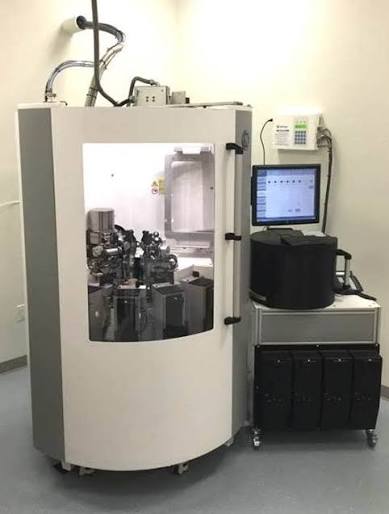
The GE SPINlab™ is a clinical-grade, automated dissolution Dynamic Nuclear Polarization (dDNP) hyperpolarizer developed by GE HealthCare to dramatically increase the magnetic resonance (MR) signal of specific molecules—most notably Carbon-13 (¹³C) labeled pyruvate—for real-time metabolic imaging.
By aligning nuclear spins before injection, it boosts MR sensitivity by 10,000- to over 20,000-fold, allowing MRI scanners to visualize cellular metabolism in vivo rather than just anatomical structure.
How It Works
- Cryogenic Polarization. The system cools samples to ultra-low temperatures (≤ 1.0–1.1 K) inside a 5.0 Tesla superconducting magnet without consuming liquid cryogens.
- Microwave Irradiation. A 140 GHz microwave source transfers high polarization from unpaired electrons (radicals) to the target ¹³C nuclei.
- Rapid Dissolution. Once polarized, superheated pressurized water rapidly dissolves the frozen sample into an injectable liquid solution at physiological temperature and pH.
- Sterile Fluid Path. Unlike earlier systems that required cleanrooms, the SPINlab uses a single-use, closed sterile fluid path (assembled with a dedicated laser welder) to maintain sterility for human clinical trials.
Key Capabilities & Specifications
- Multi-Sample Capacity. Polarizes up to 4 samples simultaneously, supporting high-throughput clinical and preclinical workflows.
- Polarization Yield. Achieves roughly 50% liquid-state polarization for ¹³C-pyruvate, delivering up to 50 mL of 250 mM solution per dose.
- Integrated Quality Control (QC). A built-in QC module automatically verifies pH, temperature, volume, polarization level, and residual radical concentration within seconds—without breaking the sterile barrier—before patient injection.
Primary Research Applications
While the SPINlab is an investigational research platform rather than a standalone diagnostic device, it is widely used at academic medical centers like Stanford Medicine and Memorial Sloan Kettering for:
- Oncology. Tracking real-time conversion of pyruvate to lactate (the Warburg effect) in prostate, brain (glioma), breast, and liver tumors to assess aggressiveness and treatment response within 24–48 hours.
- Cardiology & Neurology. Measuring myocardial viability, cardiac metabolism, and neuroenergetics in living subjects.
- Alternative Nuclei. Researchers have also adapted the platform to hyperpolarize ¹²⁹Xe gas for lung and brain perfusion studies.
Pricing and Availability
The GE SPINlab™ hyperpolarizer is not sold through standard commercial retail channels with published list prices. Because it is an investigational research platform rather than a routine clinical medical device, GE HealthCare provides custom institutional quotes directly to academic medical centers and research hospitals.
Estimated Capital & Operating Costs
- System Capital Cost. While GE HealthCare does not publish public pricing, peer-reviewed literature and institutional grant filings historically place the capital cost of a GE SPINlab system at over $1.5 million USD (with total site installation, shielding, and dedicated MRI integration projects often exceeding $2M–$4M depending on facility requirements).
- Per-Scan Consumables. Ongoing operating expenses are significant. According to research published via the National Library of Medicine, the sterile, pyrogen-free
[1-¹³C]pyruvatesubstrate, trityl radical, and single-use sterile fluid path assembly cost up to $1,000 USD per human exam, excluding the required on-site pharmacist verification and specialized MRI multinuclear coils.
Availability in the United States & Europe
- Regulatory Status. The SPINlab is sold strictly for investigational and research use (e.g., under FDA Investigational New Drug [IND] protocols in the US and Clinical Trial Applications in Europe) rather than as a standard FDA-cleared or CE-marked diagnostic device.
- United States. Available via direct institutional procurement from GE HealthCare. Installed bases are concentrated at major NCI-designated cancer centers and research universities, including UCSF, Stanford Medicine, UT Southwestern, the University of Maryland, and Memorial Sloan Kettering.
- Europe. Available through GE HealthCare’s European molecular imaging and MR research divisions, typically funded via national research councils or Horizon Europe grants. Active installations operate at major European research hubs such as the University of Nottingham, University of Cambridge, Technical University of Munich (TUM), and the Technical University of Denmark (DTU).
References
Hyperpolarized MRI – An Update and Future Perspectives
Hyperpolarized ¹²⁹Xe MRI Using Dissolution DNP on a Commercial Polarizer: From Solid-State Optimization to In Vivo Lung Imaging
Leave a Reply