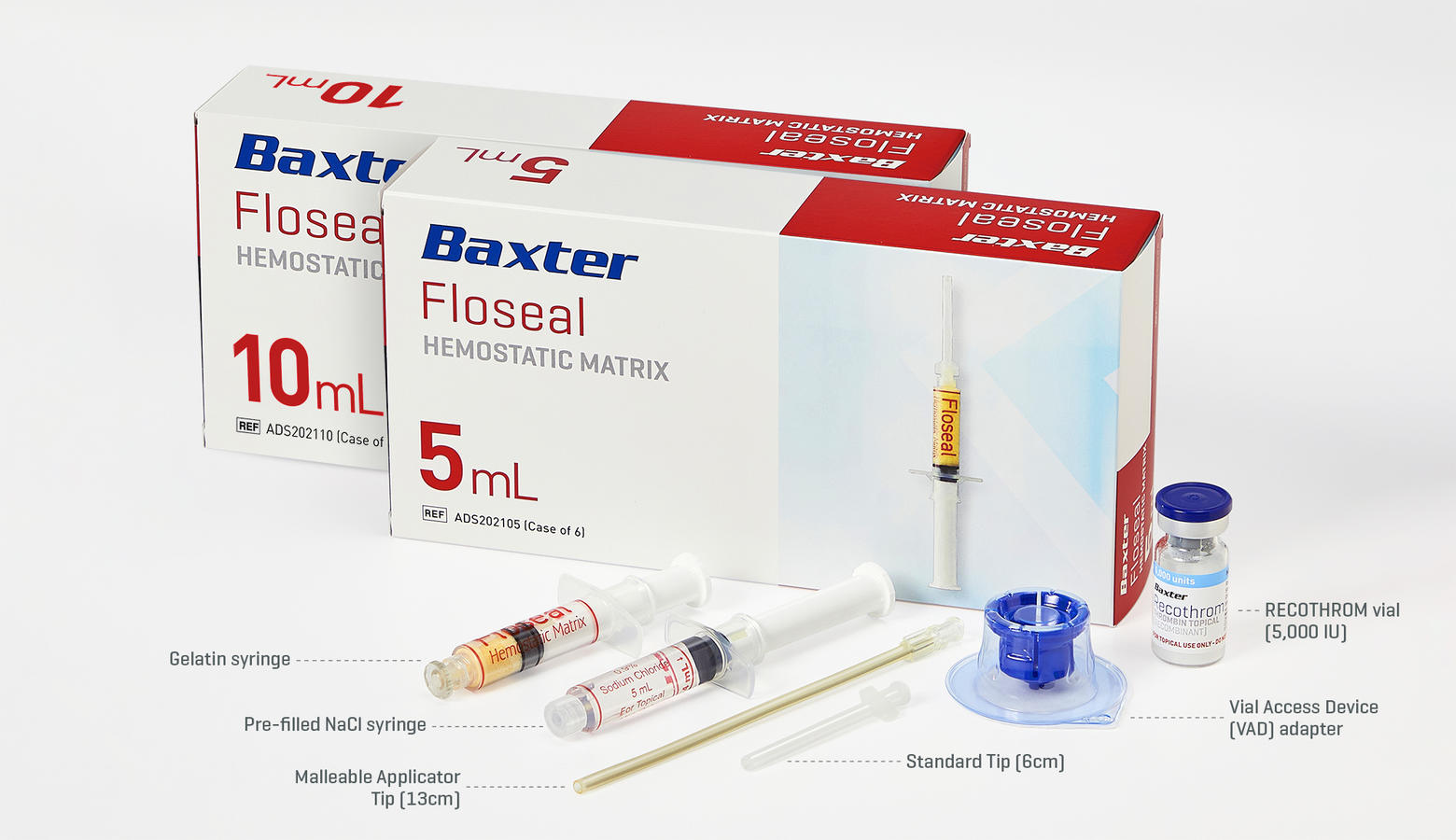
FLOSEAL Hemostatic Matrix, manufactured by Baxter, is an active flowable hemostatic agent used during surgery to control bleeding ranging from oozing to spurting. It is typically employed as an adjunct when conventional methods like ligatures are ineffective or impractical.
Core Indications
- Adjunct to Hemostasis: Indicated in surgical procedures (except ophthalmic) when bleeding control—ranging from oozing to spurting—by ligature or conventional methods is ineffective or impractical.
- Active Bleeding Scenarios: Proven effective on both bone and soft tissue and can be applied directly to wet, actively bleeding sites.
Common Clinical Uses
Surgeons utilize FLOSEAL across multiple specialties due to its high success rate (96% within 10 minutes) and speed (median time to hemostasis of ~1.5–2 minutes):
- Cardiovascular Surgery: Used to control bleeding in fully heparinized patients and has been shown to reduce transfusion rates and minor complications.
- Spinal Surgery: Frequently used to manage bleeding in bony surfaces and soft tissue during laminectomies or fusions.
- Gynecologic Surgery: Applied in procedures like myomectomies to manage perioperative blood loss.
- ENT / Sinus Surgery: Used to control operative and post-operative epistaxis (nasal bleeding).
Contraindications
- Not for use in patients with bovine allergies, in the presence of infection, or for the closure of skin incisions.
Manufacturer: Baxter International Inc.
Addresses:
- One Baxter Parkway
- Deerfield, IL 60015
- United States
Product Prices
- 5 mL Kit: Typically ranges from $300 to $500 per kit.
- 10 mL Kit: Typically ranges from $325 to $715 per kit.
Free References
FloSeal Hemostatic Matrix Instructions for Use
Systematic review of hemostatic agents used in vascular surgery
Hemostatic efficacy of a flowable collagen-thrombin matrix during coronary artery bypass grafting: a double-blind randomized controlled trial
Absorbable hemostatic agents – The pharmacology, clinical efficacy, adverse effects and toxicities
Evaluating the Efficacy and Safety of Hemofence (Thorombin Cross-Linked Sodium Hyaluronate Gel Matrix) in Hemostasis for Intractable Exudative Bleeding in Spinal Surgery: A Multicenter, Randomized, Phase III Clinical Trial
Biologic Hemostatic Agents in Obstetrics and Gynecology
Observational evaluation of outcomes and resource utilization from hemostatic matrices in spine surgery
Biomaterials as Haemostatic Agents in Cardiovascular Surgery: Review of Current Situation and Future Trends
Histological appearance of topical hemostatic agents and materials in neuropathology
Retrograde thrombosis of the superficial sylvian vein following liquid adhesive hemostat use during craniotomy: illustrative case
Leave a Reply